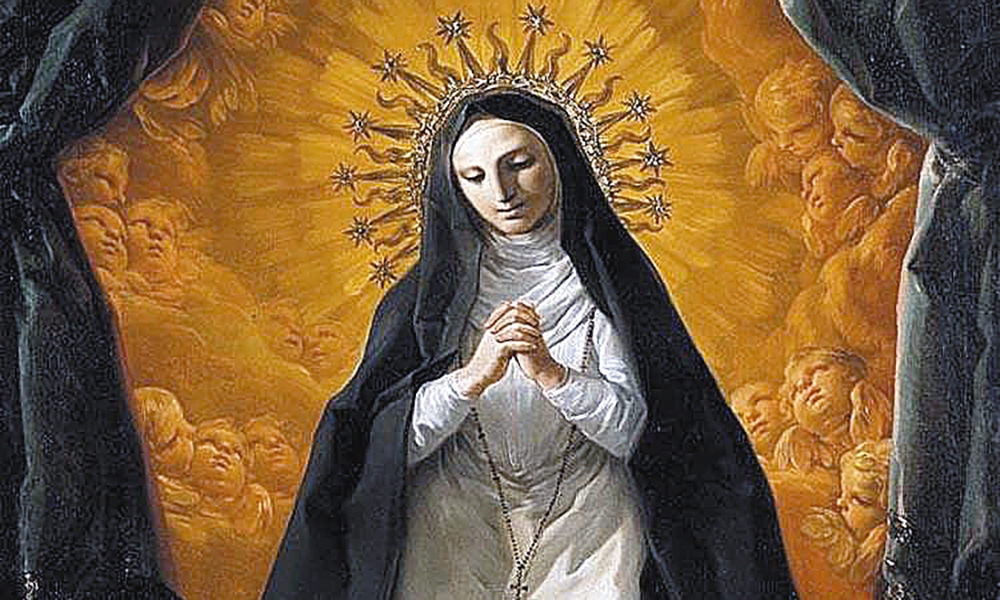
St. Margaret Mary Alacoque and the Devotion to the Sacred Heart of Jesus
Margaret Alacoque was born in 1647 in France, the only daughter of Claude and Philiberte Lamyn Alacoque.
Margaret always showed an intense love for the Blessed Sacrament and preferred silence over typical childhood play.
She began practicing severe corporal mortification after her First Communion at age nine.
As a child, she experienced a serious illness that persisted for four years.
After making a vow to the Blessed Virgin Mary to consecrate herself to Religious Life, Margaret instantly returned to perfect health.
In recognition of this favor, Margaret added the name Mary to her Baptismal name.
Margaret Mary experienced visions of Jesus Christ for most of her life.
After the death of her father, she and her family were forced into poverty.
Her only comfort in life was her frequent visits to pray before the Blessed Sacrament at a local church.
By the time Margaret Mary was 17, their financial situation improved, and her mother started encouraging her to become more social, in hopes she would find a suitable husband.
One night, after attending a ball in an evening dress, Margaret Mary had a vision of Christ, scourged and bloody.
He showed her that His heart was full of love for her in response to the promise she made to His Blessed Mother as a child.
After this vision, Margaret Mary was determined to fulfill the vow she had made to the Blessed Mother years before.
She entered the Visitation Convent at Paray-le-Monial in May of 1671 to become a Nun.
St. Margaret Mary was admitted to wearing the Religious habit in August 1671, but wasn’t officially admitted to profession until November 1672.
Although she was described as humble, simple, kind, and patient, Margaret had to prove the authenticity of her vocation.
During her time in the monastery, Margaret Mary received several private revelations of the Sacred Heart of Jesus.
These visions showed her the form of the devotion, the chief features being reception of Holy Communion on the first Friday of each month, Eucharistic Adoration during a Holy Hour on Thursdays, and the celebration of the Feast of the Sacred Heart.
The Lord Jesus requested His love be made evident through her.
In her vision, she was instructed to spend an hour every Thursday night meditating on Jesus’ Agony in the Garden of Gethsemane, a practice known as “The Holy Hour,” that later became widespread.
In December of 1673, Jesus appeared to Margaret Mary again and allowed her to rest her head on His heart.
His human heart was to be the symbol of His divine love.
He revealed to her the wonders of His love. He explained to her that he wished to make these wonders known to all the world and that He chose her for His work.
Margaret Mary eventually gained the support of the community’s confessor, St. Claude de la Colombiere, who declared her visions were genuine.
All remaining opposition from the community regarding Margaret Mary’s visions ended in 1683, when she became the assistant to the superior.
Margaret Mary, who also later became novice mistress, led the monastery in observing the Feast of the Sacred Heart privately and inspired the construction of a chapel built to honor the Sacred Heart.
Margaret Mary died several years later, at the age of 43.
On October 17, 1690, while being anointed before her death, she spoke the words, “I need nothing but God, and to lose myself in the Heart of Jesus.”
After her death, the devotion to the Sacred Heart was adopted by the Jesuits but remained controversial within the Church.
The practice did not become officially recognized until 75 years later.
Margaret Mary Alacoque was a topic of discussion long after her death.
People talked about her mission and qualities, her revelations and spiritual maxims, and her teachings on the Sacred Heart.
On September 18, 1864, Margaret Mary was beatified by Pope Pius IX.
When her tomb was opened a few years later, two immediate cures took place, and her body lay incorrupt.
St. Margaret Mary Alacoque was canonized on May 13, 1920, by Pope Benedict XV, and in 1928, Pope Pius XI upheld the Church’s position regarding the credibility behind her visions of Jesus Christ.
He stated that Jesus “manifested Himself” to Margaret, and the chief features of devotion to the Sacred Heart are the “reception of Holy Communion on the first Friday of each month, Eucharistic Adoration during a ‘Holy Hour’ on Thursdays, and the celebration of the Feast of the Sacred Heart.”
St. Margaret Mary Alacoque is the patron saint of devotees to the Sacred Heart, of those suffering with polio, and of those who have lost parents.
Her feast day is celebrated on October 16.