American Catholic History Series Part III: The Green Island
For Elowen, the “New World” had a sharp, metallic taste.
It was the taste of the soot in the Chicago kitchens where she had scrubbed floors, and the bitter copper of the coins she saved to buy her passage to the Wisconsin woods.
She had come from Ireland with a heart full of hope, but America had greeted her with a cold shoulder.
To the refined ladies in the city, she was “just a Bridget,” a second-class soul with a thick brogue and a “superstitious” devotion to the Rosary.
Even here, in the raw wilderness of the Door Peninsula, the air felt thin. She was a stranger in a land that wanted her labor but didn’t want her story.
But then, there was the chapel at Champion.
The ‘Oasis of the Lowly’
Walking toward the small wooden refuge, Elowen felt the immigrant’s ache begin to lift.
Here, a woman named Adele Brise, an immigrant like herself, saw the Queen of Heaven.
Adele didn’t talk about progress or nativism. She talked about Goodness.
She gathered the children of the mud-streaked settlers and taught them the Sign of the Cross as if it were a secret code of nobility.
“Gather the children in this wild country,” the Blessed Mother had told her, “and teach them what they should know for salvation.”
In Adele’s presence, Elowen wasn’t an alien or a servant; she was a daughter of a humble, ever-present Mother, and the Almighty Father whose royal household spanned centuries and continents.
Inside the chapel, the social hierarchy of the frontier dissolved.
On these rough-hewn planks, the second-class citizen was treated like family.
The chapel wasn’t just a building; it was the only home she had found in a thousand miles of wandering.
The ‘Night the Sky Melted’
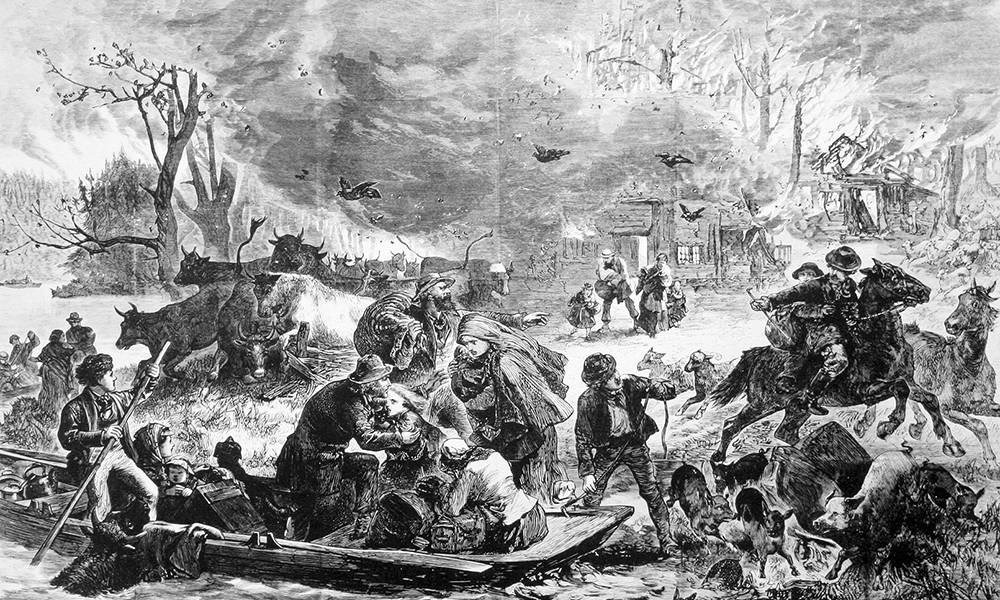
Then came the night of October 8, 1871.
The air had been eerily still for days, smelling of baked pine and dread.
Suddenly, a sound like a thousand freight trains tore through the forest. The Great Peshtigo Fire — a “tornado of flame” — was moving across the land with a hunger that consumed everything in its path.
Elowen fled. She didn’t run for the river, where others were already perishing in the frantic heat. She ran for the only refuge she had ever known.
She joined the swarm of terrified immigrants — Belgians, Irish, and Germans — all scrambling toward the small wooden fence of Adele’s chapel.
Inside the chapel, the heat was an agonizing pressure. Outside, the sky was a roaring, demonic orange.
Elowen clutched her beads until her knuckles turned white.
She looked at Adele, who looked at the simple cross above the altar and led the Rosary with a voice that refused to waver.
“Holy Mary, Mother of God, pray for us sinners, now and at the hour of our death . . . ”
As the flames licked at the very edge of the property, Elowen began to grasp a critical truth: The goodness of the Church was not a fair-weather luxury.
It was an oasis. In this moment, she wasn’t an immigrant fighting for a crumb of respect; she was a child of a Father much bigger than the fire.
She was loved by a Savior stretched out on a cross and suffering for her.
She was huddled with friends and families who may not even speak her language.
She was, for the first time in America, truly home.
The morning of the miracle
When the sun rose, the world was a charred, blackened heap.
For miles in every direction, the earth was nothing but white ash and the smoking skeletons of torched trees.
Except for the five acres under Our Lady’s protection.
Elowen stepped outside and fell to her knees.
The grass was green. The chapel was standing. The wooden fence was charred on the outside as if the flames had reached the boundary and been told, “No further.”
Everything outside the fence was death; everything inside was life, a Green Island of Divine Providence: A miracle of the Father’s love.
Goodness and home
In this “Green Island,” the American Catholic story reaches its fulfillment.
- The Spanish preached the truth (The mission).
- The founders discovered beauty (The liturgy).
- But it was the immigrant who understood the goodness of the Church as a transcendent home.
Evangelization is more than a sermon; it is the act of building a fence against the fires of the world. It is the promise that no matter how far you have traveled, or how little the world values you, there is a “Green Island” where you can be part of the Divine Household.
Like Elowen, we are all looking for the fire shelter. We are looking for a refuge.
Jesus reminds us: “In my Father’s House there are many rooms” (John 14:2).
We are a pilgrim people longing for shelter; we will not be home until the day Jesus says, “Well done, my good and faithful servant” (Matthew 25:23).
But for these transient days and for more than five centuries on this continent, the Church has been whispering to the native, the missionary, the patriot, the immigrant, you and me and everyone we know: “Come in. Until the great pilgrimage of life is over, this is your home.”