American Catholic History Series Part II: Mr. Washington and Mr. Adams go to Mass
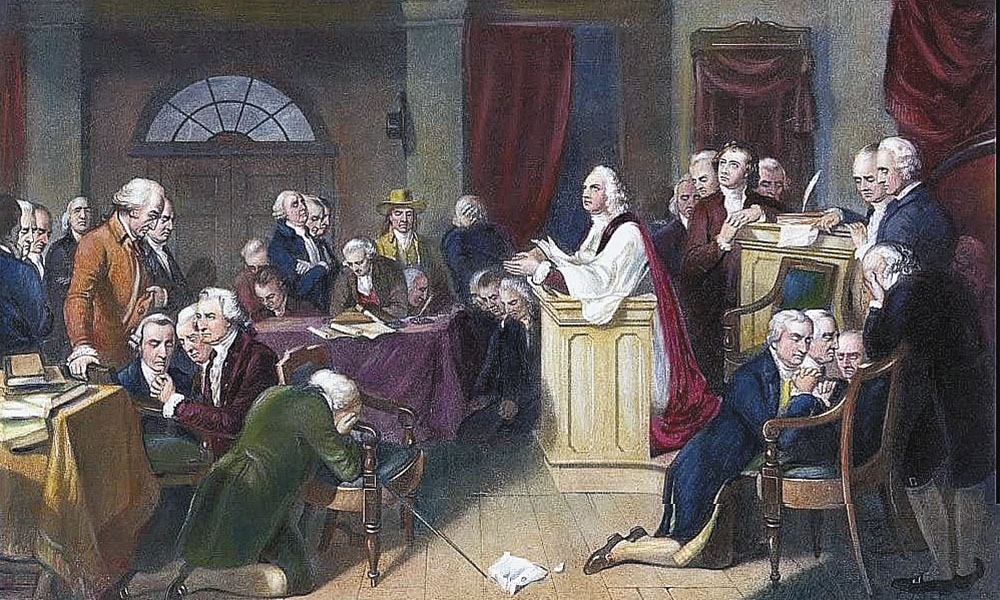
The Sunday sky over Philadelphia in October 1774 was a flat, discouraging gray.
Inside the taverns, the air was thick with tobacco and the heavy talk of treason.
The First Continental Congress was deadlocked, and for men like John Adams, the pressure of a looming revolution was a physical weight.
Looking for relief from the “tedious” debates of the State House and obligatory “perpetual round of feasting,” Adams found himself drawn alongside the towering Virginian, Col. George Washington.
They gravitated toward an unlikely refuge: A narrow brick building on Fourth St. known as St. Mary’s Catholic Church.
For Adams, a man of the “Plain Style” and the austere Congregationalist pulpit, entering a Romish chapel felt like stepping into a forbidden theater, a scandal to Enlightenment rationality.
But for Washington, the pragmatic soldier, it was an inspection, a survey of the heart of an ally.
“Col. Washington, what good is there to stoop into the halls of popish superstitions? Aimless chanting, bowing, and superfluous décor is no remedy for the pomp and drudgery of the business of Congress.”
“On the contrary, Mr. Adams, even you must admit the curious practice of the Roman faith has an order and discipline — and any feasible ally against our oppressor, be they French or Spanish, is unanimously devoted to it.”
As they crossed the threshold, the Enlightenment world of cold logic vanished.
They were met not with a lecture, but with an assault of the senses.
The air was thick, heavy, warm, and redolent of ancient, smoky things: Beeswax and the sweet-sharp cloud of incense.
In his later letters to his wife, Abigail, Adams would describe the scene with a mix of Protestant suspicion and raw, artistic wonder.
He scoffed at “the poor wretches” fingering their beads and muttering their “Pater Nosters” and “Ave Marias.”
But then, the organ breathed.
It was a profound, resonant beast that invigorated the very floorboards.
A choir began to chant, weaving a tapestry of sound that lifted the smoky air toward the ceiling.
Adams, the man of the Enlightenment, felt his defenses stumble.
He called the experience “most awful and affecting,” but the organ and choir touched him “most sweetly and exquisitely.”
Washington, for his part, fixed his eyes on the crucifix above the altar.
Framed in marble, in agonies, blood dropping and streaming from His wounds, hung our Savior, pouring out His life for His people.
In response, the congregation bowed at his Holy Name whenever it was spoken, and knelt at the words of His covenant sealed by His sacrifice.
Adams wrote famously of that afternoon:
“Here is everything which can lay hold of the eye, ear, and imagination — everything which can charm and bewitch . . . I wonder how Luther ever broke the spell.”
Witnessing beauty
What Adams called “bewitching,” we call the Via Pulchritudinis: “The Way of Beauty.”
While his own tradition focused on the mind, the Catholic Mass lays claim to the whole person.
He saw the “pomp and grandeur”: The candles, the gold leaf, the white robes of the priest, and perhaps realized that humans are not just thinking machines.
We are embodied souls, incarnate spirits, who crave the tactile and the transcendent.
While Adams wrestled with the mystical, Washington observed the order.
He saw the wealthy merchant kneeling beside the dockworker, both attentive to their Master.
He saw a discipline and a community bound in a transcendent covenant that no secular contract could replicate.
In this moment, the Federalist ideology of the Founders converged with Catholic anthropology.
Human nature is fallen, prone to passion and rebellion; a Republic, our founders noted, could not survive on reason alone.
It needs the moral anchor that religion provides. But more, the human heart seeks transcendence: An incarnate experience of the sacred that prevails over the mind and senses and commands respect and affection.
Washington and Adams left St. Mary’s that day as Protestants, but perhaps the encounter moved in them something more intrinsic.
They had seen that the Catholic Church was not a foreign threat — though perhaps they were not entirely moved from that deep sentiment — but as a pillar of social order and a school of the Incarnation, the “Grandmother Church” that could bring much-needed transcendence to this great American experiment.
Reaching the whole person
For us today, the lesson is clear: Evangelization proclaims the Gospel to the whole person.
Before a neighbor listens to our arguments about dogma, we ought to befriend them with authentic charity, stir in them the a of mystery in the liturgy, and attract them with our joy.
Adams wondered how the “spell” was ever broken; our mission is to show the world that grace and mercy are not sorcery, but rather the power of the Gospel and the only thing that can truly set a nation free.