American Catholic History Series Part I: Mass in the Marshes
The first sound was not a voice, but a vibration. A bronze bell, pitted by salt air, struck a single, clear note that rippled across the coastline of present-day Georgia.
For a moment, the ancient choir of frogs and cicadas fell silent, as if the wilderness itself were holding its breath.
To the man watching from the edge of the maritime forest, the sound was a summons from an inner mystery, a deep resonance he had always sensed but never named.
He was Guale — a son of the tides and the live oaks — and his heart, like the dark, soil beneath his feet, was rich and fertile — ready to receive the seed.
He turned his gaze toward the large chiki of the newcomers: A massive structure of tabby and timber, thatched with palmetto fronds and crowned with a rugged wooden cross.
Beside him, a Spanish soldier in breastplate and helm adjusted his sword. An uneasy foreignness lingered between them, yet as a third gong rang out, the soldier and the Guale stepped together over the threshold.
They stepped out of the wild and into another world.
Inside the mission chapel of San Pedro de Mocama, on what we now call Cumberland Island, the air was a thick, holy mystery.
The sharp, resinous scent of burning frankincense collided with the damp, earthy smell of the salt marsh.
In the dim light, the Guale man — not yet Baptized — fixed his eyes on the crucifix above the altar.
There hung the image of a naked man, bloodied and fixed to a cross.
The intense face of the man stared back at him with an expression of agonizing love.
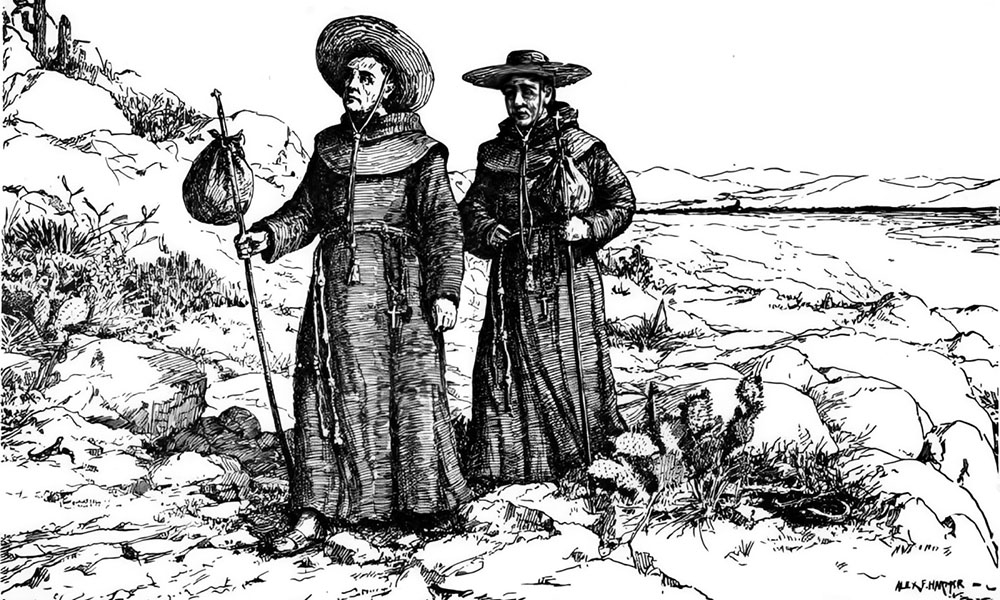
The brown-robed Franciscans stood. They began to lead a small band of converts in a mesmerizing polyphony.
The harmonized voices of the missionaries and neophytes were a bridge; the Latin lyrics linked this rustic San Pedro Mission across the Atlantic, reaching all the way to Rome.
There, amid a forest of scaffolding, the great dome of St. Peter’s Basilica was finally rising toward the heavens as Pope Clement VIII processed to the thunder of Vatican choirs.
The Georgia marsh and the Roman marble were, for this hour, one and the same.
The Guale man watched as Fr. Pedro de Corpa approached the altar with a deliberate, ceremonial grace.
The Mass proceeded in a rhythmic harmony of ancient Latin and prosaic Spanish.
Then, a shock: A friar, Fray Miguel de Añón, stood to the left of the sanctuary and began to speak the man’s own Guale tongue.
He spoke of a Mico, or Cacique — a Great Chief — who did not demand the blood of his people, but offered His own.
Then came the silence.
The bells rang out again, three sharp peals that anchored the spirit to the earth.
Father Pedro lifted a snow-white Host, momentarily covering the face of the bloody man on the cross.
In that moment, the Incarnate Reality kissed the virgin soil.
Whether whispered as Corpus Christi, el Cuerpo de Cristo, or as Iesu Christo hachi imitile (Jesus Christ, our Life), the truth was the same.
The man, who was later Baptized as Diego, is confounded: The Great Chief is also the bloody man on the cross and the Bread of Life?
This was not a foreign ghost or a distant deity. The Real Presence was there.
In a great mystery, this was the Mico around whom his Guale people and these
Spanish strangers could finally build a life — even eternal life.
The seed was planted. Long before any pilgrim set foot on Plymouth Rock, the Gospel had its effect in the hearts of the indigenous people.
As the Spanish Franciscans and French Jesuits set up their missions throughout the Americas, the New World was opened and received the graces of the Real Presence of Jesus in the Most Blessed Sacrament.
For reflection and conversation
- The First Thanksgiving: For 120 years between Columbus and the Mayflower, the intercultural act of fellowship, grace, and gratitude on this continent was the celebration the of Holy Eucharist. How does this balance with the prevailing narrative of pre-British America?
- Incarnation in the Wild: The friars used Guale concepts (like the Mico) to explain Christ. How can we better use our own local culture to explain the Gospel today?
- Venerables Fr. Pedro de Corpa and Fr. Miguel de Añón were later martyred in 1597 along with three other friars when Father Pedro forbade a baptized Guale chief, Juanillo, from taking a second wife. Am I prepared to be patient, persevering, and reliant on the Holy Spirit to bring the Gospel to our modern culture?
- In our next installment, we move north to a little-known “Romish Chapel” on the peripheries of intense deliberations at Liberty Hall in October 1774, where the faith of the missions is integrated into the ideological conception of a new republic.