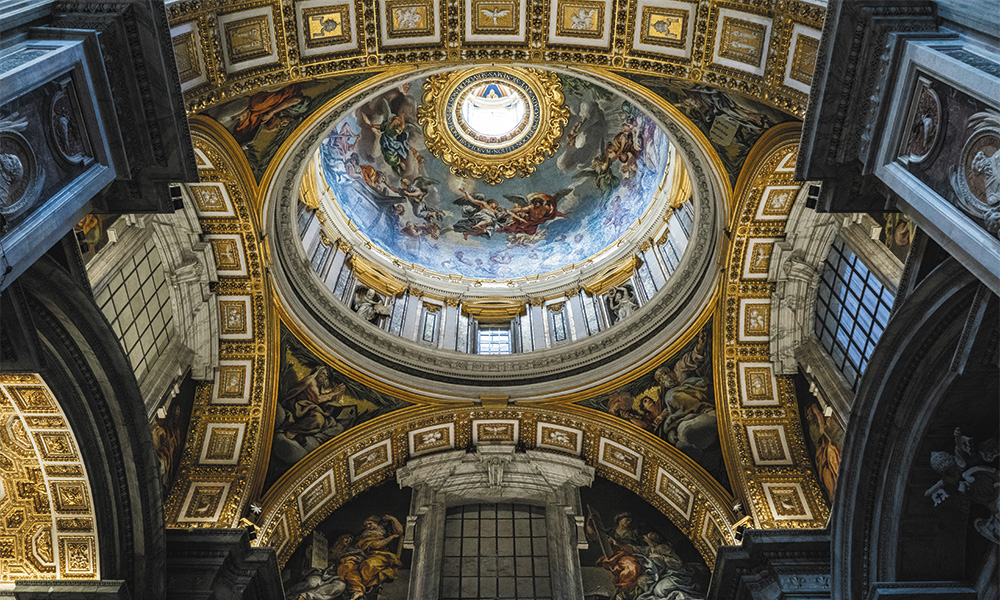
Beauty to reflect the glory of God
On November 18, the Memorial of the Dedication of the Churches of Ss. Peter and Paul, Pope Leo XIV will celebrate a special Mass to commemorate the 400th anniversary of the completion of St. Peter’s Basilica.
The global symbol of Catholicism, St. Peter’s is magnificent in its Baroque splendor and enormous scale. One’s first experience of entering it remains a powerful memory.
Built in the 16th and 17th centuries to replace the original church, the Basilica houses the tombs of many saints and popes, most significantly the mortal remains of St. Peter himself.
During World War II, Pope Pius XII authorized archaeological excavations beneath St. Peter’s to determine the existence of the apostle’s tomb.
These experts discovered an astonishing cemetery beneath the basilica, going back to the time of Christ, with a consensus emerging that this necropolis was most certainly the burial site of St. Peter.
Millions of pilgrims and tourists visit St. Peter’s Basilica, stunned by its splendid beauty, astonishing size, and precious artworks, including Michelangelo’s Pietà, and uplifting architecture, topped with the magnificent dome designed by Michelangelo.
Beauty from the Church
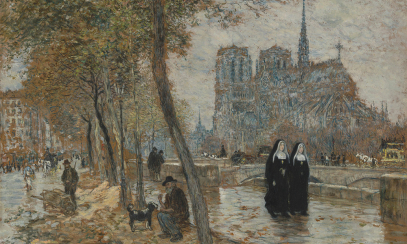
Throughout its long and expansive history, the Catholic Church has sponsored and created enduring works of beauty in paint, stone, metal, cloth, and wood.
The greatest Renaissance masters all worked for popes, who commissioned churches, frescoes, statues, paintings, tombs, and liturgical vessels and vestments to reflect the beauty and glory of God.
The Church’s understanding of beauty as a fundamental attribute of God is reflected in the millions of works of art which She created, preserves, and uses.
This sacramental vision of God made visible in the person of Jesus Christ, the beauty and order of nature as the handiwork of the Father, and the dignity of the human person, created in the divine image, all inform the Church’s passion for artistic achievement.
Da Vinci’s Last Supper invites us into the pathos, love, and meaning of the first Eucharist.
Michelangelo’s Sistine Chapel ceiling reveals the glory of God’s creative power with the epic figure of Adam receiving the vivifying touch of the Father.
Rafael’s fresco of the School of Athens illustrates how the philosophical thought of the ancients finds its fulfillment in Christian revelation.
Beauty at home
Fortunately, we do not need to travel to Rome to experience the beauty of God refracted through the artistry of the Church.
Many of our local churches are beautiful in their simpler way, drawing us into the worship of God and the mystery of His presence and love.
We thank our ancestors for their sacrificial generosity, which created such a rich legacy for us.
Some would argue that externals do not matter, that Mass celebrated in a plain or even ugly space still contains the fullness of the Eucharist.
We can certainly emphasize the externals too much, if we are so caught up in the beauty of a church, the design of a vestment, or the liturgical form of a Mass, that we remain unmoved to the interior action of the Holy Spirit in our worship and prayer.
But externals do matter because we are sensory human beings, affected by our environments and surroundings.
The sound of uplifting music, the smell of incense, the taste of the Eucharist, the feel of Rosary beads, the vision of stained glass all lead us to the Lord and serve as sacramentals of His Truth, Beauty, and Goodness.
The popes built St. Peter’s Basilica during the Protestant Reformation, when the unity of Western Christianity suffered an enduring division, to proclaim the solidity, tradition, and historicity of the Catholic Church, going all the way back to St. Peter, who was crucified upside down on Vatican Hill, not far from the ancient Egyptian obelisk which stands in the middle of St. Peter’s Square.
This enormous piazza, designed by Bernini, is defined by a stunning, stone colonnade which appears as a pair of beautiful, open arms, welcoming and receiving all of God’s children into the maternal embrace of the Church.
When Pope Leo celebrates the commemorative Mass this month, amidst all the splendor of the Basilica, everyone will pass through those welcoming arms once again, which stand as an enduring symbol of the love and mercy of the Lord.
That’s where all great Catholic art takes us!