Thomistic Institute on UW campus
MADISON — UW-Madison students who are seeking the answers to deep questions have a fantastic resource available to them.
The Thomistic Institute, founded at the Dominican House of Studies in Washington, D.C., has a chapter on campus at UW-Madison.
The Thomistic Institute was founded in 2009.
Its mission is to help students grapple with life-changing questions by providing a place to take those questions seriously, dialogue with fellow students and teachers, and encounter the teachings of the Church, especially the wisdom of St. Thomas Aquinas.
A big part of how they do this work is through campus chapters – local branches that host regular events to provide opportunities for encountering the Catholic intellectual tradition.
Campus chapters became part of their structure about 10 years ago, and they already have more than 100 chapters.
In addition to supporting intellectual work on college campuses, the Thomistic Institute also produces Aquinas 101, a video series that helps make St. Thomas Aquinas approachable through short videos and online courses, both available for free.
Evangelizing with St. Thomas
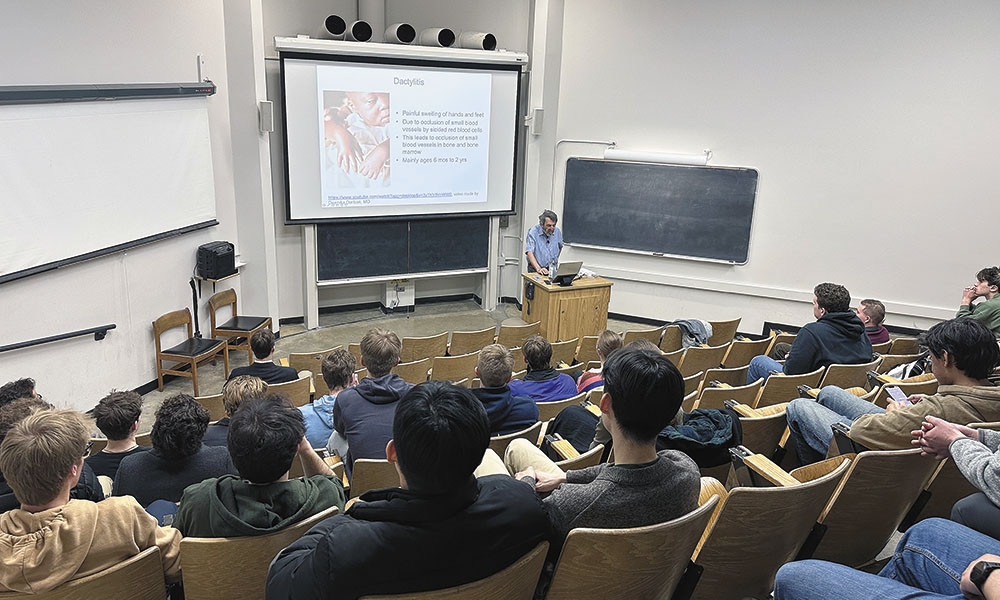
The support of the national Thomistic Institute allows the UW-Madison campus chapter to host three lectures a semester, bringing in professors and other scholars to speak to students and the general public.
“We use these as a point of forming people that already are Christian, and then also as a point of evangelization for the Church,” said Jacob Bever, president of the campus chapter.
They also have weekly reading groups on Thomistic philosophers, both St. Thomas himself and others.
“We use St. Thomas Aquinas just because he has so much philosophy that has been put out on a large variety of topics . . . we use a lot of that kind of philosophy in our readings and our lectures,” Bever said.
“He has so much theology and he’s really good at combining faith and reason and showing how they work together, which is a big part of the Catholic intellectual tradition,” he said.
“It all largely came from [Aquinas]; even though he does reference Augustine, Aristotle, and other philosophers, he’s kind of the general base of theology.”
“[He] addresses a lot of questions that are highly debated today, like the existence of God, ethics, human nature, and science and how that relates to God.”
Bever himself is a recent convert who had a love for the Catholic intellectual tradition and encountered a representative of the Thomistic Institute at SEEK 2025 in Salt Lake City.
He felt drawn to bring it to UW-Madison “because we don’t really have anything like it . . . We would get to bring the Catholic intellectual tradition to a larger square: Students, the public, whoever is able to attend or wants to attend.”
Truth appeals
These events are opportunities for students to encounter the truth.
“It is definitely desirable on a campus because you do have all these people who are quite smart, attending university, and that’s who we’re trying to appeal to.”
And that appeal is very needed.
“Especially on UW-Madison, because this campus definitely is not known for being particularly Catholic or even Christian . . . There are a lot of philosophies that are contradictory to the Catholic philosophy of Aquinas, so [we use it] as a way to combat . . . these normalized kinds of things that the Church would not agree with,” Bever said.
“Particularly, I’m thinking of things like abortion, sexuality, and all that kind of stuff, that’s very normalized on campus.”
“It’s a largely . . . atheistic or agnostic campus in my experience,” he said.
“So [we bring] those big questions of ‘Does God exist?’, ‘Does evil disprove God?’, ‘How can we reconcile the Big Bang with the Creation story?’, doing that kind of discussion to . . . bring people into more knowledge about Christianity, and Catholicism specifically.”
And that knowledge can make a big difference.
Many young people, whether Catholic or not, are simply unaware of the depth and rich legacy of the Church when it comes to exploring science and reason.
Some young people might assume that the Church is built only on people’s faith experiences or emotional journeys. But the Church is built on Truth.
Of course, the Church is fundamentally relational – Truth is a Person, after all.
But her answers to life’s questions are not shallow, subjective, or unable to handle debate. Quite the contrary.
The Church welcomes science and reason, and embraces the sometimes difficult work of exploring truth across a myriad of fields and intellectual disciplines.
The Thomistic Institute provides a way for people to experience faith and reason as harmonious partners in the search for truth.
That experience can be a valuable one for young adults as they determine what role Faith will play in their intellectual lives – and their lives in general.
Upcoming events
The Thomistic Institute at UW-Madison has two upcoming lectures, both of which are free and open to the public, no registration required.
On Monday, April 6, at 6:30 p.m., they will have a lecture entitled “Does evil disprove God?” by Dr. Walter Matthews Grant. It will take place in room 1651 in the Humanities Building on the UW-Madison campus.
On Tuesday, April 14, at 6 p.m., there will be a lecture entitled “If God doesn’t exist, science is impossible,” by Dr. Wes Siscoe. It will take place in room 1101 of the Humanities Building.
For both lectures, there will be someone at the entrance to direct people to the specific room.
To learn more about the national Thomistic Institute, or access Aquinas 101, visit thomisticinstitute.org