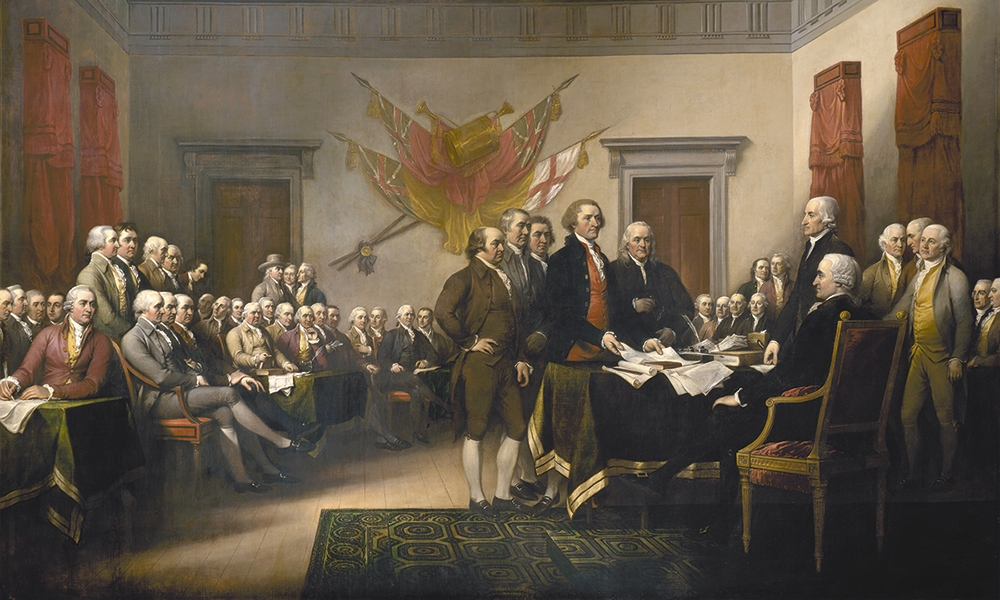
The spirit of Freedom
The candlelight in the rented Philadelphia room flickered against the sticky June heat, casting long shadows across the heavy oak table.
John Adams paced the floorboards, his boots striking a structured cadence.
“It must be framed as a matter of legal compact, gentlemen!” Mr. Adams declared, gesturing aggressively toward John Locke’s Two Treatises of Government.
“The Crown has violated the social contract. They have infringed upon our property, our trade, and our chartered rights. Locke is clear: When the ruler breaches the contract, the people’s allegiance is dissolved. It is a matter of rational ethical certainty.”
Roger Sherman, the time-honored Connecticut Puritan, somberly folded his hands on the table.
“Mr. Adams, your Locke treats society like a mere business partnership, a utility to protect worldly estates. If our rights are purely contractual, they can be renegotiated by the next strongman who takes the bench. Liberty is not a social contract, sir, but rather a divine covenant. We are here to recognize a creation, not sign a lease!”
“A covenant requires shared theology, Mr. Sherman!” Mr. Adams shot back, his voice rising in irritation.
“We represent thirteen colonies comprised of Puritans, Anglicans, Quakers, and Deists. A legal contract is the only language explicit enough to bind them all.”
Benjamin Franklin, nursing his gout-swollen leg near the window, sighed heavily.
“Gentlemen, the heat is souring our tempers and clouding our judgment. I move for a recess before we tear the parchment before it is even written.”
Grateful for the reprieve, Thomas Jefferson stepped into the cooler, shadowed hallway of the State House to clear his head.
“You look like a man carrying the weight of an empire, Mr. Jefferson.”
Jefferson turned to see Charles Carroll of Carrollton approaching.
Though not a member of this drafting committee, the wealthy Marylander was an invaluable voice in the Continental Congress — and the assembly’s lone Roman Catholic.
“Not an empire, Mr. Carroll,” Mr. Jefferson replied with a weary, formal nod.
“An alternative to one. Mr. Adams and Mr. Sherman are locked in combat. One insists on a social contract of property; the other demands a sectarian covenant. I am trapped between a machine and a pulpit.”
Mr. Carroll leaned against the wood paneling, his expression sharp and analytical.
“They are debating a false dichotomy, sir. They assume freedom must either be a cold human invention or a rigid theological edict.”
“And do you possess a third way, Mr. Carroll?”
“Not mine, sir. The Jesuits who educated me in France taught a far deeper political architecture. They pointed to St. Robert Bellarmine. When King James I claimed a divine right to rule over men, Bellarmine systematically dismantled his position. He argued that political authority is indeed ordained by God, but that God vests it directly in the populace because all men are equal in their fundamental nature. The people then entrust that power to rulers. It is at once a sacred trust and a popular right.”
Mr. Jefferson froze. The name Bellarmine struck a chord of memory.
“Bellarmine . . .” Jefferson murmured, his mind racing back to his study at Monticello.
“Sir Robert Filmer’s Patriarcha.”
“A royalist tract?” Carroll noted, raising an eyebrow.
“Yes, but Filmer structures his entire defense of monarchy by desperately attempting to refute Bellarmine!” Mr. Jefferson’s eyes narrowed in sharp recollection.
“He quotes the Cardinal extensively to mock him. I have those passages in my library, Mr. Carroll. Bellarmine wrote that political power resides in the multitude, and that for legitimate reasons, the people can change their form of government.”
“Precisely,” Mr. Carroll said.
“True liberty is not a practical matter of property rights or distribution, as Locke claims. Rather, liberty is a natural expression of God’s design for humanity, both communal and individual. We are all equal, sir, and we govern by mutual consent under God.”
Armed with a sudden, brilliant synthesis, Jefferson hurried back into the committee room.
Adams paced, and Sherman returned to his seat, both still brooding in stubborn silence.
Mr. Jefferson sat at the center of the table, dipped his quill, and began to write with fluid authority.
“Gentlemen, your attention,” Mr. Jefferson called out, cutting through the heavy air.
“We hold these truths to be self-evident, that all men are created equal, that they are endowed by their Creator with certain unalienable Rights . . .”
Mr. Adams halted his pace, turning to listen.
“That to secure these rights, Governments are instituted among Men, deriving their just powers from the consent of the governed.”
Sherman looked up, satisfaction breaking through his stern demeanor.
“Creator. Yes. Take rights out of the hands of parliament entirely, Mr. Jefferson.”
“And place authority exactly where it belongs, Mr. Sherman,” Jefferson replied.
“The government derives its power from the people, who hold it as a sacred trust from God. If a king turns tyrant, he does not merely break a contract with man. He commits sacrilege against human dignity, the very Image of God.”
Mr. Franklin smiled from the shadows. “Now, gentlemen, here is a truth that could unite a nation.”
Nickolas Wingerter is the associate director of evangelization and catechesis for the Diocese of Madison.