The first document of Vatican II Sacrosanctum Concilium
This is the second of a series examining the continued relevance of Vatican II documents in Catholic life today.
If you walked into a Catholic church on a Sunday morning in 1960, the experience would feel quite different from what it does today. The priest stood with his back to the congregation, speaking in quiet, precise Latin. The choir sang complex melodies from a distant loft, while many in the pews silently prayed the rosary or read along in private, translated missals.
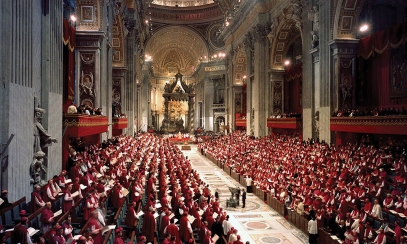
This was the context into which the Council Fathers released Sacrosanctum Concilium (The Constitution on the Sacred Liturgy) on Dec. 4, 1963. As the very first document promulgated by the Second Vatican Council, it signaled that before the Church could look outward to reform her relationship with the modern world, she first had to look inward at how she prayed.
The vision
The introduction to Sacrosanctum Concilium articulates the Council’s overarching goals. The Council sought to “impart an ever-increasing vigor to the Christian life of the faithful” and to adapt those institutions subject to change “more suitably to the needs of our own times.” (no. 1) Furthermore, the Council wanted to foster whatever could promote union among all who believe in Christ and strengthen whatever could help all humanity into the Church’s fold.
It was in light of these goals that the Council undertook the reform and promotion of the liturgy. After all, the liturgy builds up those in the Church and increases its power to preach Christ. Consequently, it is through the liturgy that the Council’s goals might most readily be achieved.
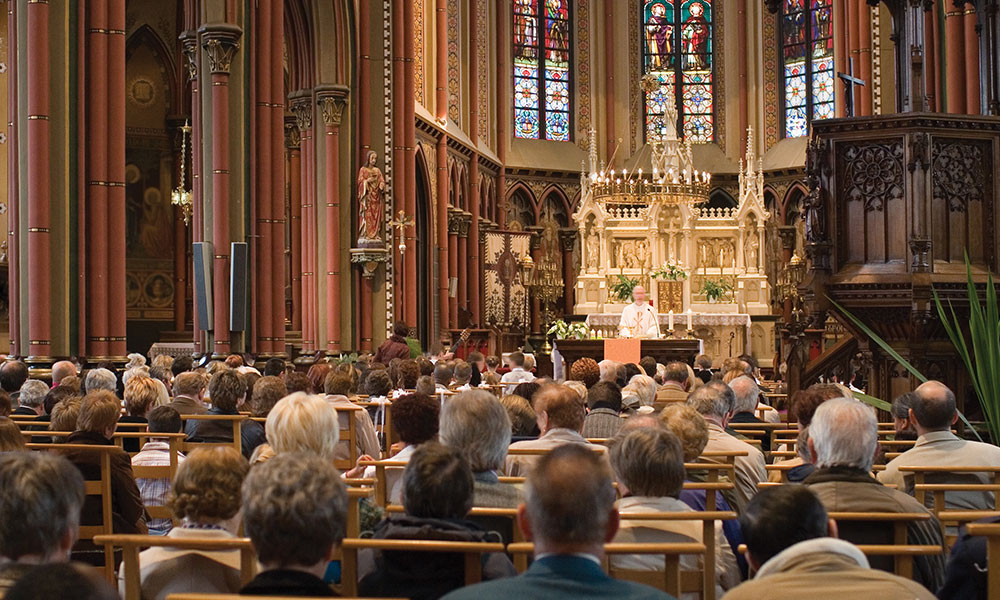
For the Council, this meant that the faithful were, first and foremost, called to “fully conscious, and active participation in liturgical celebrations.” (no. 14) The Council Fathers explicitly stated that the Christian people are not meant to be “strangers or silent spectators” (no. 48) at Mass. Instead, by virtue of their baptism, Catholics have a right and a duty to offer the sacrifice together with the priest. The liturgy was not to be viewed as a private act of the cleric that the laity merely watched; it was the communal work of the entire Mystical Body of Christ.
The key reforms
To achieve this active participation, Sacrosanctum Concilium set forth a series of practical reforms. For instance, while the document noted that “the use of the Latin language is to be preserved in the Latin rites” (no. 36), it encouraged a wider use of the vernacular in the readings, prayers and hymns so the people could understand what they were hearing.
The Council ordered that the treasures of the Bible be opened up in a more expanded fashion. This resulted in a new three-year Sunday Lectionary, which greatly increased the scope of sacred Scripture proclaimed at Mass.
The rites were simplified to make their theological meaning and paschal character more transparent. Ancient practices, such as the Prayer of the Faithful (General Intercessions), were reintroduced. There was a renewed focus on congregational singing, and Catholics were encouraged to receive Communion under both species (bread and wine) in specific circumstances.
In addition, Sacrosanctum Concilium permitted culturally appropriate music and instruments provided they were aligned with the dignity of worship. Of course, this did not mean the Gregorian chant and the pipe organ were devalued. Both continued to be held in high esteem by the Church.
The lasting impact
Sacrosanctum Concilium reminded the Church that the Eucharist is the "source and summit" of the Christian life. This constitution teaches that our work, our theology and our personal devotions all flow from the altar and must ultimately lead back to it.
Pope Leo Catechesis on Sacrosanctum Concilium
Pope Leo XIV is currently addressing the Second Vatican Council in a catechetical series during his Wednesday audiences. On May 20, he began his catechesis on Sacrosanctum Concilium, highlighting several key themes in the document. He said that it is “in the holy liturgy, through the power of His Spirit” that God continues to sanctify and unify his Church. Pope Leo invited the faithful to join him in “allow[ing] ourselves to be shaped inwardly by the rites, symbols, gestures, and above all by the living presence of Christ in the liturgy.”
Did You Know?
Sacrosanctum Concilium clearly states that the regulation of the sacred liturgy “depends solely on the authority of the Church, that is, on the Apostolic See, and, as laws may determine, on the bishop.” Consequently, “no other person, even if he be a priest, may add, remove, or change anything in the liturgy on his own authority.” (no. 22)
Doug Culp is the chief operating officer for the Pontifical Mission Societies of the United States.