Area missionaries serve people in El Salvador
ATEOS, EL SALVADOR — A group of Wisconsinites recently led another successful medical mission trip to Ateos, El Salvador.
Working with the Catholic organization Helping Hands Medical Missions (HHMM), the team has built a remarkable impact over the years.
This year, they provided medical care to almost 1600 people in a week.
The team consisted of 54 people, eight of whom were medical providers — doctors, nurse practitioners, etc.
The team also included nurses, pharmacists, translators, and volunteers.
Whether a person had a medical background or not, there was more than enough work for everyone.
Many people in El Salvador live without running water or electricity.
The conditions create their own health challenges, such as more infections, in addition to diagnoses that occur much like they would in the United States, such as hypertension or diabetes.
The team is supported by an excellent local ground crew, who coordinate lodging and transport, and arrange for locations that can function as clinics.
There is also a lot of support from within the Diocese of Madison: Financial support, prayer, and active participation.
For instance, members of St. Cletus Parish in southeast Dane County, including some who are homebound or wheelchair bound, make Rosaries, toys for the kids, and glasses cases for the missionaries to distribute.
The team takes a priest chaplain every year, and in 2026, Bishop Donald J. Hying of Madison traveled with the team.
“That was a lot of fun for all of us, to get to meet him and see his personality come through,” said Bill Brue, a retired EMT on his second mission.
This mission has been traveling to El Salvador since 2015. By this point, not only has the team’s growing size and many veteran members increased its impact, but they’ve been able to commit to proactive, multiyear projects.
They’ve fundraised to expand the local parish school, increasing the functionality of a facility that serves almost 900 students in grades K to 12.
They’ve also increased access to clean water.
One of the frequent diagnoses seen by the team over the years has been parasite infections due to contaminated water.
Starting in 2017, the team began distributing water filters.
They gave away around 400 of them in 2026.
Costing about $40 each and lasting ten years, the filter allows a family access to clean water.
The team’s been able to see the improvement as cases of infection decrease.
The team also distributes glasses.
Watching people smile as they are able to see clearly — perhaps for the first time in years — is absolutely heartwarming.
Learning to walk
For many patients, this is the only medical care they will receive all year.
The team offers whatever specialties they can, depending on the providers traveling with them: dentistry, chiropractic, physical therapy, NFP training, etc.
One pair of patients stood out to several team members.
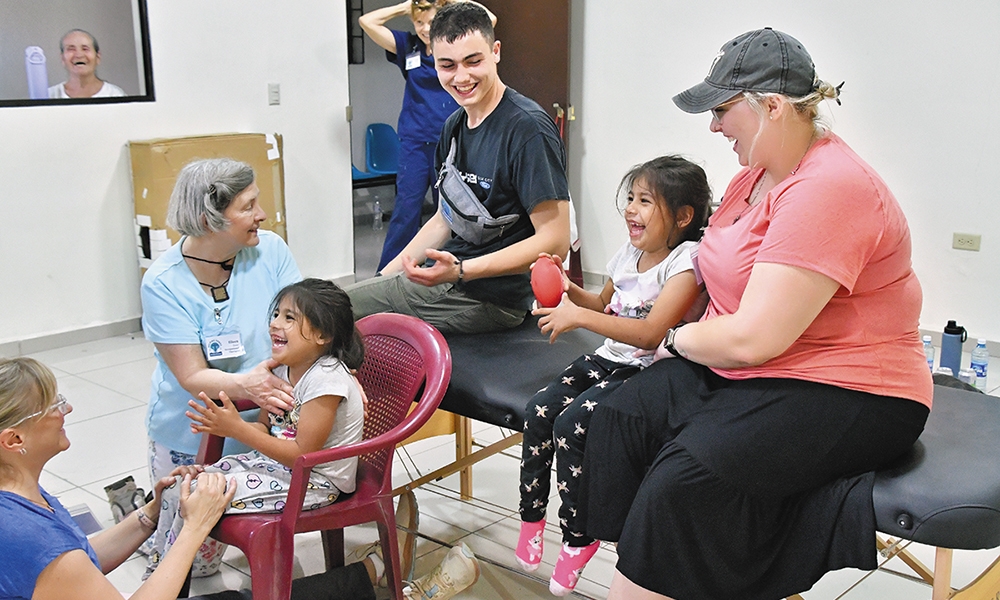
Twin girls — six years old — came in on the last day.
“I think they were, like, in a shopping cart,” said Brue.
“I thought it was just to entertain them, to have them ride in a shopping cart. [But it was] because they didn’t have a wheelchair.”
The twins had been born prematurely and never learned to walk.
“Our therapy team came together to create a plan and teach their mother exercises she could continue at home to help strengthen the girls and prepare them for walking. We are also working with local resources to help them receive continued care,” said Jessica Phelan, a nurse practitioner who served as lead provider on this year’s mission.
“We met them during the very last patient slot on the final clinic day, just as we were packing up to leave. By God’s grace, we were able to see them before the mission ended, and now these girls are on a path toward learning to walk.”
“The girls were so delighted,” said Brue.
Powered by prayer
Of course, due to the makeshift facilities, there is much the team can’t do — sometimes a diagnosis requires specialized equipment or ongoing treatment.
Those limitations are humbling, but even when the team can’t help medically, there is immense gratitude for their presence.
“The people we met in El Salvador were patient, joyful, and so grateful,” said first-time missionary Kelly Detra.
“There were a number of people who touched me deeply . . . I pray for them daily.”
That encounter is at the heart of the mission — HHMM provides medical care, yes, but the essential word there is “care.”
The team is trying to offer the love of Christ to each patient.
More important than the medical treatment, appreciated as it is, is the encounter that says: Your suffering is not unnoticed. You are loved.
To accomplish this loving encounter, prayer is essential.
The team stays at a retreat center, which lacks air conditioning but is refreshing in other, more important ways.
They have daily morning prayer and Mass, hold a mini-retreat on Sunday, and usually gather in the evening for talks or discussion.
“Everything is so God-centered,” said Ginny Joyes, communications coordinator for the team and a veteran missionary.
Praying with patients or inviting them to visit the priest while they are there is a natural part of the clinic day, and many patients offer their prayers for the missionaries.
Phelan was profoundly impacted by the prayerfulness of these missions.
“Five years ago, before my first mission trip, I was not Catholic. However, after witnessing the faith of the Salvadoran people and the devotion of my fellow missionaries, I felt called to learn more about the Catholic faith. When I returned home, I joined RCIA and eventually converted to Catholicism. Now, one of the parts of the mission I look forward to most each year is the spiritual retreat.”
Plans for the next mission — which will take place in March of 2027 — are already underway, and they are seeking missionaries. To learn more or get involved, contact Ginny Joyes at elsalvadormissionmadison@gmail.com.