What happens in seminary formation
People are often surprised to learn that seminary formation takes a minimum of seven years.
Why so long? What actually happens in those years of seminary formation?
A journey in discipleship
Published by the United States Conference of Catholic Bishops in June of 2022, the sixth edition of the Program of Priestly Formation (PPF) lays out the current program for seminary formation.
It included some significant changes from the previous edition, most notably the terms for the stages of formation.
No longer is seminary described in terms of academic content, such as Philosophy, College, Pre-Theology, or Theology.
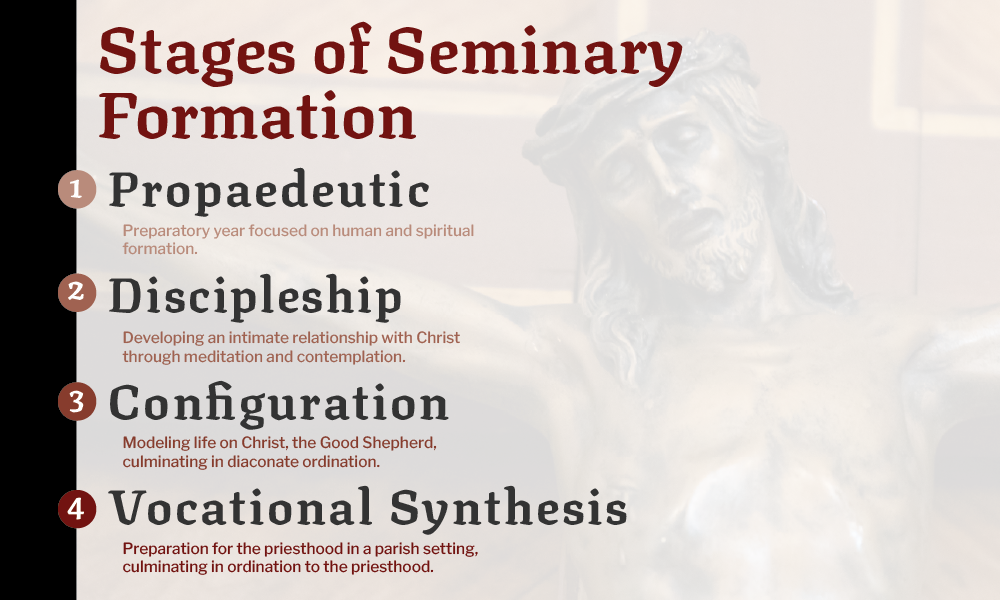
In their place, we have new terms, which perhaps sound like something from a sci-fi novel: Propaedeutic, Discipleship, Configuration, and Vocational Synthesis.
These new terms reflect an “integral” view of priestly formation: Formation for the priesthood is not about earning academic credits but about following Christ in a journey of discipleship.
The journey begins in one’s Baptism, where one “puts on Christ” (Gal 3:27), and seminary is meant to intensify this journey.
The result of these seven to eight years of seminary should be that a man learns to pattern (“configure”) his life after Christ, the Good Shepherd.
The Church knows that such a journey does not happen overnight, so the stages of seminary provide a gradual approach for a man in formation.
The first stage is a Propaedeutic, or preparatory, year.
This year is focused mostly on the human and spiritual dimensions of Christian formation.
A man in this stage will take a deliberate step away from academic studies, live in a smaller community, and grow in knowledge of himself and the Church’s spiritual patrimony.
The year includes a technology fast, with limited access to cell phones; poverty immersion, in which the seminarians live and work among the poor; and pilgrimage experiences.
Additionally, the Propaedeutic Stage allows for greater discernment.
By the end of this first year, both the seminarian and the seminary will gain clarity as to whether the man is called to continue with seminary formation or take another path of discipleship.
Continued growth
With the foundation laid in the Propaedeutic Stage, a man continues his growth in virtue in the Discipleship Stage.
This stage includes the study of philosophy and continued focus on spiritual and human formation, with the goal that the seminarian develops an “intimate relationship with Christ through the life of meditation and contemplation” (PPF 132).
He builds the prayer life and closeness to Jesus that will be the foundation for the rest of his life.
Next, a seminarian enters the Configuration Stage, in which he prepares to model his life on Christ, the Head and Shepherd, who laid down His life for His sheep.
The seminarian studies theology, and he begins the proximate formation for ordination.
He wears the priestly collar, and his formation is geared toward the work he will soon undertake, such as preaching, hearing Confessions, and offering formation in the Christian life.
The Configuration Stage culminates in ordination to the diaconate.
The final stage, the Vocational Synthesis Stage, represents a time of transition into parish life and further priestly identification.
Now ordained a deacon, the seminarian concludes his preparation for the priesthood by living and working in a parish so as to accustom himself to life outside the seminary.
He takes on some pastoral work and gets an inside look at parish administration before he assumes all the responsibilities of the priesthood.
After a minimum of seven to eight years, the seminarian is finally ordained a priest.
Let’s return to our original question: Why does seminary take so long?
Because the priest, as St. John Paul II said, acts “in the name and person of Christ himself,” and seminary is a time of gradually conforming one’s life to the Person the priest represents.
Fr. Jared Holzhuter is the vocations director for the Diocese of Madison.