More than food and presents
I once asked my mother to describe the Christmases of her youth.
A Depression-era kid born in ’26, she imparted that she considered it to be THE most boring day of the year: Their small home wall-to-wall with old fogies, no freedom to see her friends, the movie house and pool hall closed, and no presents except maybe an orange. She couldn’t wait for the calendar to read “26th.”
My father, too, rarely spoke of his childhood Christmases, except to reiterate that a piece of fresh fruit (all your own!) was a big deal, and that his family once had a real tree with real candles — that somehow didn’t set the house afire. He was one of 11 children and was born in 1919.
Despite those somewhat dark beginnings, the magic that is Christmas, a magic capable of implanting a warm, fuzzy feeling into the toughest psyche, did make its way into the hearts of my beloved parents, albeit at different speeds.
Whether slightly more predictable German (my father) or highly unpredictable fighting Irish (my mother), bloodlines really played no role in the transformation; a rock-solid faith, grace, and the milestones of life brought it about.
Christmas past
An up-close-and-personal look at Europe as a soldier in World War II was just such a milestone for my dad.
He was a first sergeant in Patton’s 5th Armored Division, 34th Tank Battalion, Combat Command A, and operated a radio in a half-track.
On Christmas Eve of ’44, he found himself in Belgium, headed for a six-hour alert on the front line for possible engagement in the Battle of the Bulge.
The Americans had taken occupation of the little town of Baelen some days before, and tried to avert their minds from not only combat, but cold — the worst the country had seen in 50 years.
As they walked the tiny streets in the early hours of Christmas Eve, they came across an old piano in a building the U.S. had commandeered.
My father looked around at his company and said, “This might be the only thing we’ll have for Christmas.”
A born talent who played anything by ear, he gently put his fingers to the keys and began to croon carols as only his beautiful baritone could; somehow, I feel “Silent Night” was likely the first selection. Christmas would never be the same for any of them again.
But if that wasn’t a Christmas miracle sufficient enough to strengthen their weary hearts, they were given another.
Having survived the six-hour alert without seeing combat, Dad received the command call to move back; the 34th was being relieved!
As they made their way out and Christmas morning dawned, they found the chow line brimming over with a full Christmas meal: Turkey, dressing, potatoes, pie . . . “the whole nine yards.”
What it must have meant to those men to pierce such a fearful 48 hours with a little piece of peace.
As for my mother, she seemed to me a borderline Grinch when I was a kid, perhaps finding it hard to escape the ghosts of Christmases past.
She did everything up just right for us, of course — a big fresh tree, plenty of presents, the fancy meal — but she didn’t seem to approach any of these maneuvers with great anticipation or excitement.
I recall her focus always being on Christmas Mass, and on not being awakened at some unholy hour of the morning — which gave birth to our modus operandi of opening gifts on Christmas Eve.
That is usually a German tradition, but in our house, it was absolutely an Irish-French maternal edict.
Christmas gifts of all kinds
Mom really did not go a-gush over Christmas until the advent of grandchildren.
And though her transformation was later than Dad’s, it was probably the most profound.
There was not a detail left to chance in those early returns to the homestead for Christmas.
Her homemade candy went well beyond a pan of fudge, with a platter of caramels, toffee, and almond bark that seemingly refilled itself.
Dad happily jumped on this warm and fuzzy bandwagon, as his old fashioneds and Shirley Temples began flowing upon arrival, and never stopped for the duration.
We sledded, made snowmen, and enjoyed the flashback to childhood as the kids tore up the old basement when everyone needed a warmup.
After the post-meal nap came the stroll up the graveled road — cigars usually in hand.
Eventually, we opened presents, although one year the babes bounded up the steps after the greatly anticipated “call to gift opening!” only to be greeted with Mom’s immortal words: “Before presents, a Rosary.”
In this ultimate Kodak moment of mouths agape, my husband glanced at the grandkids, turned to my sister-in-law, and softly whispered, “Trapped . . . like rats.”
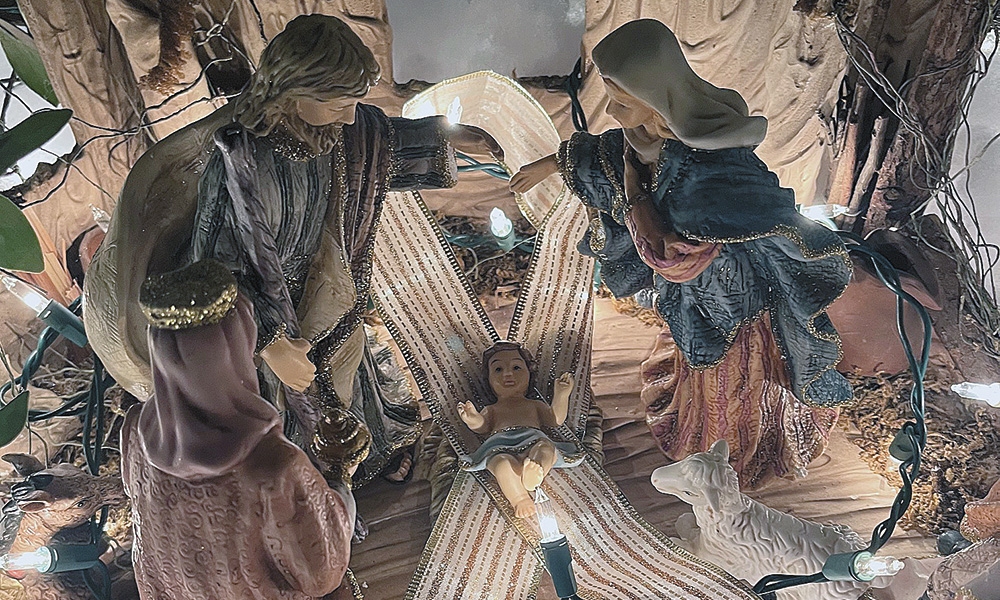
At Mom and Dad’s lead, young and old, we hit our knees around the crèche and the tree, and delivered probably the fastest rendition of the five Glorious Mysteries known to man.
If memory serves, our darlings found it all worth the wait, and most definitely still recall their Grandmommy saying, “I want you to always remember that Christmas is about SO much more than food and presents.”
At nightfall, we bundled up once more, grabbed the champagne and marshmallows, and huddled around Dad’s campfire out back.
The air was crisp, the stars were brilliant, and I can still hear our four-part carols filling the hush of the December night . . . floating . . . as if en route to the man in the moon.
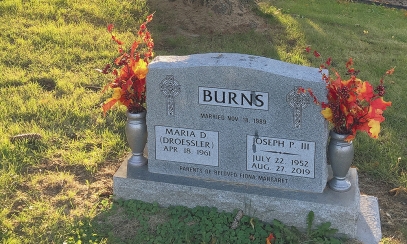
You think it will never end, but turn ‘round one day to find your parents at rest — their lessons, their wisdom, and the true meaning of Christmas are forever alive as deeply-etched memories in your heart.
Maria Burns is a lifelong Catholic and writer who lives in Madison and is a member of Divine Mercy Parish in Madison.