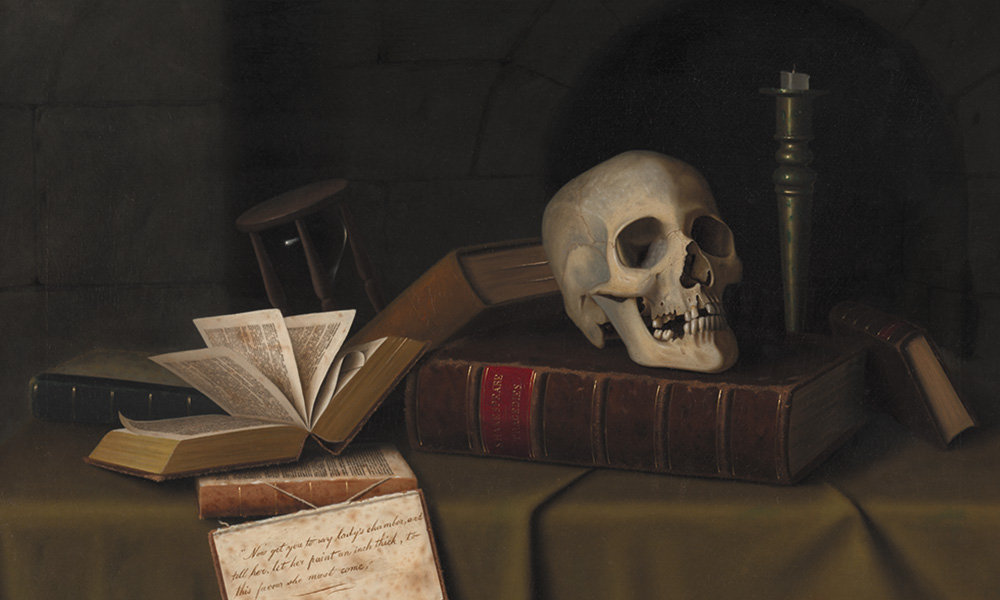
Living Memento Mori
As we settle into the dark of the upcoming winter, the Church gently turns its focus toward the four last things: Death, Judgment, Heaven, and Hell.
In our modern culture, death is often treated as a taboo subject. We see death as something to be hidden, delayed, or avoided at all costs.
Yet, for centuries, Catholic tradition has offered a strikingly different path through the ancient Latin practice of memento mori: “Remember your death.”
Far from being a morbid or somber obsession, memento mori is a call to live fully in the present light of eternity.
For a disciple of Jesus Christ, remembering that our earthly lives are fleeting is not a source of despair, but the key to unlocking profound freedom, clarity, and intentional joy.
What to ‘remember’
The phrase memento mori literally translates to “remember that you must die.”
In ancient Roman tradition, a victorious general parading through the streets would have a servant whispering these words in his ear to remind him of his mortality amidst the applause.
Early Christians embraced and transformed this concept through the lens of the Resurrection.
How does this ancient memory alter the way we live as Catholics today?
Scripture reminds us repeatedly of the temporal nature of our earthly journey.
Sirach 7:36 tells us, “In all you do, remember the end of your life, and then you will never sin,” while St. Paul urges in Colossians 3:2, “Set your minds on things that are above, not on things that are on Earth.”
Even in the ashes marked on our foreheads every Ash Wednesday, we hear: “Remember that you are dust, and to dust you shall return.”
Acknowledging that our Earthly lifespan has an end forces us to confront what truly matters and what will pass away. It reorders our priorities.
Daily anxieties, Earthly wealth, social status, and small grievances lose their grip on our hearts.
We stop living for the temporary rewards of this world and begin building up treasure in Heaven.
It also heightens our gratitude. When we realize that today is not guaranteed, every breath, every encounter, and every gift becomes a grace.
We begin to treasure our families, our parish communities, and our time with God with renewed reverence.
My own journey
Without me realizing it at the time, memento mori played a defining role in my own spiritual journey.
In high school, driving home after yet another grueling sports practice to face hours of homework, a heavy thought hit me: Why does any of this matter?
I could achieve every goal, graduate with honors, play college tennis, and secure a successful career — but eventually, I will die, and how much will it even matter? Why was I pouring so much effort into things that were ultimately so temporary?
That existential question led me to stop by my church on the way home.
Sitting in the darkness of the empty pew, an immense peace washed over my angst.
The next morning, I attended daily Mass and encountered Jesus truly present in the Eucharist.
The realization struck me deeply: If Jesus loved me enough to die so that I could live forever with Him, then eternity is the only goal that truly mattered. In an instant, my priorities shifted.
Ultimately, I still pursued my Earthly goals, but they were no longer my idols. They became opportunities to love and serve the Lord.
That high school realization is the heart of memento mori.
When we stop measuring our worth by temporary achievements, our entire perspective on life and discipleship transforms.
If we truly believe that eternal life with God is the ultimate end of every human soul, we cannot remain indifferent to those around us.
Remembering our own mortality gives us a holy urgency to share the kerygma, the Good News of Jesus Christ, Who conquered death once and for all.
It sounds counter-intuitive, but living with our death in mind grounds our Christian joy.
Christian joy is not naïve optimism; it is a deep, unshakeable confidence anchored in Christ’s victory over the grave.
St. Paul boldly writes in 1 Corinthians 15:55, “Where, O death, is your victory? Where, O death, is your sting?”
A disciple who does not fear death becomes remarkably free to love radically, give generously, and serve selflessly.
Living memento mori does not mean dwelling on the darkness of the grave.
It means keeping our eyes fixed on our goal of eternal life with Christ.
When we remember our death, we remember Who made us, why we are here, and where we are going.
Let us carry this holy awareness into our daily lives, giving witness to a world searching for hope, that death does not have the final word — Jesus Christ does.