It’s all stoppage time
I grew up in a football family. Soccer didn’t come into the picture for me until I had kids who played it.
I’d watch from the sidelines, blown away by how much the players had to run, which appeared to be 10,000 more miles than in a football game, but completely confused by the rules and the players’ roles on the field — except for the goalie. At least I understood his job.
Over time, I started to understand what being offside meant — mostly — and that games can end in a tie unless they can’t, and then you need to do a shootout against the poor goalies, and that “breaking someone’s ankles” isn’t an act of violence. It just means faking them out as you dribble past them.
Becoming a fan
My soccer watching was limited to high school games until this summer, when the World Cup ushered in a wave of soccer fever across the nation, sweeping me right along with it.
Suddenly, I was watching multiple soccer games a week on TV.
Our evening plans revolved around the nightly matchup.
I knew the star players. I learned the rankings. I filled out a bracket, having the U.S. win it all, of course.
I loved seeing the fans decked out in their teams’ colors.
I was entertained by the football stadiums filled with soccer fans who cheer differently than football fans, notably with drums.
I was charmed by nations all over the world coming together to play the same sport, speaking the same language of corner kicks, headers, hand balls, and yellow cards.
I got choked up when John Denver’s “Country Roads” played after U.S. wins. I understood why soccer is called “The Beautiful Game.”
It really is, except for one thing. No matter how much I grow in my appreciation for the sport, there is one aspect about soccer that I simply cannot comprehend, tolerate, nor accept: Stoppage time.
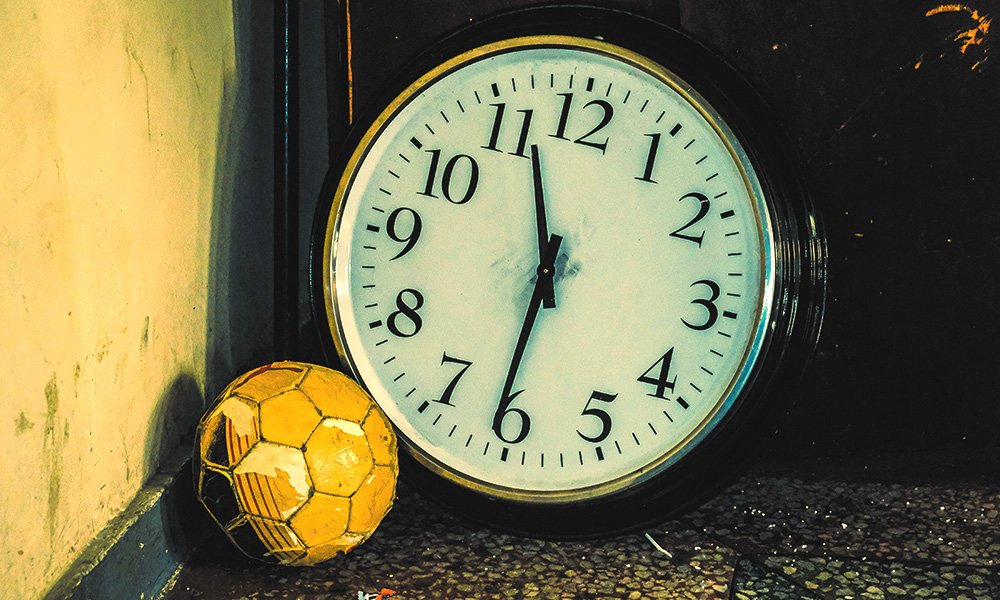
Stoppage time is the extra “mystery time” at the end of the game that only the ref knows about.
If play stops for some reason, such as an injury, the clock unfathomably keeps running.
Privately, the ref keeps track of how much time went by during the stop and adds that time to the end of the game.
Each half is 45 minutes long plus stoppage time. So when the clock hits the 45-minute mark, halftime doesn’t swoop in with its commercials and snack break.
The game just keeps going until the ref decides it’s time to stop. And if there’s an injury during stoppage time, that adds even more mystery time to the end.
If, after all the stoppage time goes by in a late-stage World Cup game and the game is still tied, do you know what happens? The game goes into two periods of “extra time” that can also have stoppage time!
My American heart can’t handle not knowing exactly how much time is left in a game.
Could you imagine a football coach not knowing if there was 20 seconds or 20 minutes of play left? Incomprehensible!
After multiple games saw me pleading with the TV, “Stop the clock!” when a player went down, it occurred to me why not knowing how much time was left bothered me so much — because it’s too close to real life.
Watching the clock
None of us know how much time is left on our own clocks. God in His infinite wisdom has deemed all of our time on this earth as stoppage time.
Whether we’re debating with friends about who we should cheer for next after our team was knocked out of the tournament, vacuuming up potato chip crumbs after the watch party, or searching for new dip recipes for the next game, even the smallest moments of our lives can become extraordinarily precious when we remember that only the ref knows how many more of them we have.
Shrouded in mystery time, powered by faith and determination, sustained by snacks and hydration breaks, and enlivened with music, friendship, and fun outfits, it is indeed “The Beautiful Life.”
“Oh, if only all could understand how precious time is, undoubtedly everyone would do his best to spend it in a praiseworthy manner.” — St. Padre Pio
Meg Matenaer is a wife, mom, and writer residing in the Diocese of Madison.