This Advent, reflect on the gift of time
The calendar fills up fast in December. There are school concerts to attend, gifts to wrap, and cards to mail.
Advent is meant to be a season of waiting and anticipation, but for many of us, it turns into a sprint to Christmas.
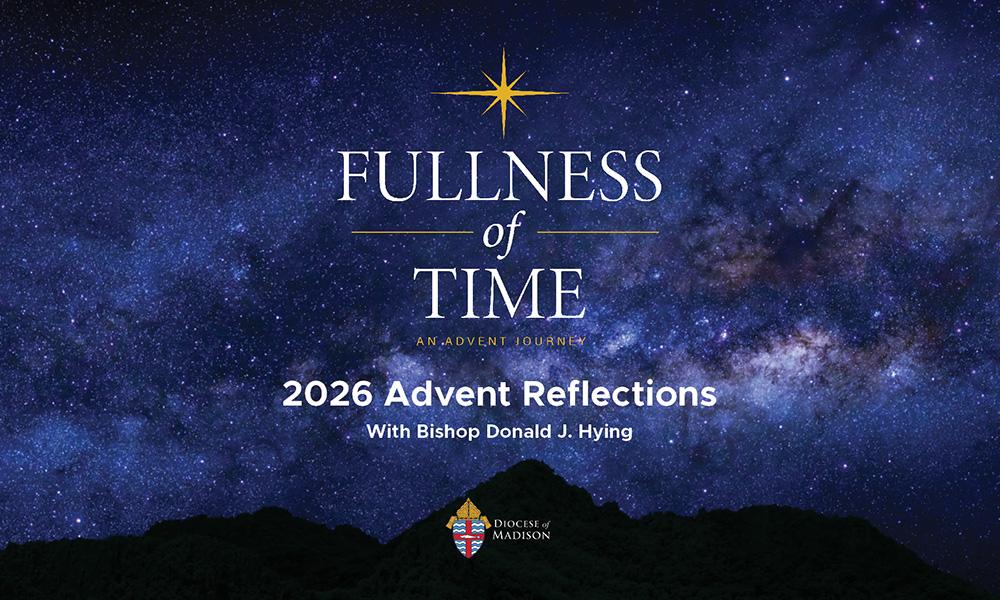
Bishop Donald J. Hying of Madison’s new Advent study program, “Fullness of Time,” speaks to that tension.
The bishop invites us to look differently at the time we already have and to notice what God is doing in it.
The four-week study program begins November 29, the First Sunday of Advent, and follows the Sunday Gospel readings for the season.
Each week takes up a different dimension of time: the past, the present, the future, and the fulfillment of time in Christ.
“I invite all of you to join me, to ponder the gift of time,” Bishop Hying said.
“[Ponder] this gift that the Lord has given us, to live these days, months, and years growing in ever more profound union with Him and in love for one another as we prepare to enter into the timeless beauty of God’s Heavenly world.”
The theme comes from St. Paul’s Letter to the Galatians: “But when the fullness of time had come, God sent his Son, born of a woman, born under the law, to ransom those under the law, so that we might receive adoption” (Gal 4:4-5).
Participants can work through the study program on their own, with family or friends, or in a parish small group.
Each week includes a video reflection from Bishop Hying, reflection questions and a discussion guide, prayers, a weekly saint to learn from, and practical ways to grow in virtue.
Materials are available in English at madisondiocese.org/advent2026 and in Spanish at madisondiocese.org/adviento2026
The first two weeks look to the future and the past.
November 29: The Future
The Gospel for the first Sunday of Advent is Mark 13:33-37, where Jesus tells His disciples to stay awake because they do not know the hour of His return.
Bishop Hying notes that the reading surprises him.
We expect Advent to look back at Christ’s birth, but the Church turns its gaze to the future and the end of history.
Seeing where history is headed helps us understand the significance of both the past and the present.
The week’s virtues are “hope” and “patience.”
Bishop Hying distinguishes hope from optimism and points to God’s own patience in unfolding His plan, from the first promise in Genesis to the birth of Jesus in the “fullness of time.”
“Optimism is simply this bland thought that somehow things are naturally going to get better. We don’t know how. Hope is made of sterner stuff,” Bishop Hying said.
St. Lucy, a young martyr in Sicily, shows how hope and patience can carry a person through suffering with joy and peace.
December 6: The Past
The Gospel for the second Sunday of Advent is Mark 1:1-8, where John the Baptist proclaims repentance in the wilderness and announces that the Messiah is near.
Bishop Hying describes John as “the last of the Old Testament prophets” and “the first of the New Testament saints,” a figure who takes us from expectation to fulfillment.
If Week One invited us to look forward, this week the Church invites us to look back at the prophecies of Isaiah and King David and at the saving events through which God entered human history.
The week’s virtue is “Faith,” which allows us to read the Scriptures as more than stories. St. Francis Xavier, who sailed to the Far East knowing he would never return home, shows what God can do with a person who believes.
Bishop Hying also draws on St. Peter’s reminder in the week’s second reading (2 Peter 3:8-14) that God gives us time to repent.
“As long as we have breath in our bodies, God is giving us one more hour, one more day, one more year to get it right, to convert,” Bishop Hying said.
Looking ahead
The December 10 issue of the Catholic Herald will introduce the next weeks.
Week Three focuses on John the Baptist’s announcement that the Messiah is already among us, and on how perseverance and patience help us stay present to God in the busyness of the season.
Week Four turns to the Annunciation and Mary’s “yes,” and asks, as Bishop Hying puts it, what “Annunciation moments” God may be placing in our own lives.